SOP — Dry Hopping
FUERST WIACEK Version 1.5 | Cellar — all fermentation tanks | Frequency: per dry-hopped batch (typically Thursday)
Purpose
Dry hopping is performed after fermentation is complete. A VLB micro-sampling sample is taken beforehand. For cold-dry-hopped beers a VDK pass is confirmed before dry hopping; for warm / West-Coast beers the VDK check is done after the dry hop (dry-hop hop-creep can restart fermentation) — not before. The goals are consistent hop character, minimal oxygen pickup, and a safe, repeatable process.
Standard timing: dry hop on Thursday. 1st cone dump Monday (4 days later). 2nd cone dump Wednesday if required (see Cone Dumping SOP).
PPE Required
Warning
Do not approach open tanks or work at height without full PPE.
- Safety goggles
- Gloves
- Ear protection
Risks
| Hazard | Risk |
|---|---|
| Working at height | Falls |
| High tank pressure | Spray or sudden release of beer or gas |
| Overflow / blow-off during CO₂ bubbling | Beer loss, slipping hazard |
| Falling objects | Hop boxes, tools, or PPE falling from height |
| Cuts | Scissors / knife when opening hop bags |
| Hop particles | Eye irritation — keep goggles on at height |
| Foreign objects in tank | PPE, gaskets, hop sacks — check before closing |
| Gaskets | Can fall to floor or into tank when port is opened |
Equipment
- CO₂ line
- Forklift
- Scissors or knife
- Alcohol spray
- Pitcher with PAA solution
- Plastic pallet (for staging hops at height)
Tank Reference
| Type | Tanks | CO₂ connection |
|---|---|---|
| Old tanks | 1, 2, 3, 5, 6, 7, 9, 10, 11 | Racking arm — tanks 1, 2, 3, 5, 6, 7. Standing pipe — tanks 9, 10, 11 |
| New tanks | 13, 14, 15, 17, 18, 19 | Standing pipe |
| Blending / hop gun | 16 | If dry hopped, treat as old tank |
Old tanks access via manhole. New tanks access via dry hop port (approx. 10–15 cm wide).
Process
1. Pre-Conditions
Dry hopping requires: - 2 days at 12°C since knockout (cold dry hop; warm / West-Coast beers dry hop at 20°C without cooling first) - VLB sample taken (micro-sampling, before dry hop) - VDK pass confirmed — cold-dry-hopped beers only. Warm / West-Coast beers skip the pre-dry-hop VDK; their VDK is done after the dry hop once gravity is stable (hop-creep re-test) - Botec fermentation recipe is at Ready for Dry Hop — if not, discuss with the team before proceeding
2. Yeast Dump
Drop remaining yeast from the cone and racking arm / standing pipe before adding hops. Confirm with the team whether this yeast is needed for harvest before dumping. Refer to the Cone Dumping SOP.
3. Prep Hops
- Leave hops in their cartons. Use grey boxes for any overflow if space is tight.
- In cold storage, bags must never be stored without cartons. If you need fewer bags than a full carton, leave the carton in storage and transfer your bags to a grey box or a carton that still has space.
- Stage hops on a plastic pallet. Bring a pitcher of PAA and scissors.
- Use the forklift to bring the pallet to height. Prepare your working space at the top of the tank before opening anything.
4. Attach CO₂ and Pressurise
- Attach the CO₂ line to the racking arm or standing pipe (see tank reference above).
- Purge the line and free space using the standard purge process, then tighten the connection.
- Remove head pressure from the tank via the CIP arm valve — open slowly until flow stops and goes quiet.
- Begin bubbling CO₂ into the beer via the racking arm or standing pipe.
- You should feel CO₂ coming out of the CIP arm — some flow is normal and expected.
- Set pressure slightly higher initially — CO₂ breaking out of solution can cause strong flow at the start, which will settle after a few minutes.
Warning
Watch the tank continuously during CO₂ bubbling. If you hear the beer getting loud or see foam rising fast, close the CO₂ immediately and open the blow-off. Wait until the blow-off slows and the beer settles before continuing.
5. Open Tank
New tanks (13, 14, 15, 17, 18, 19): 1. Open the dry hop port. 2. Place the port cap and gasket into the PAA pitcher.
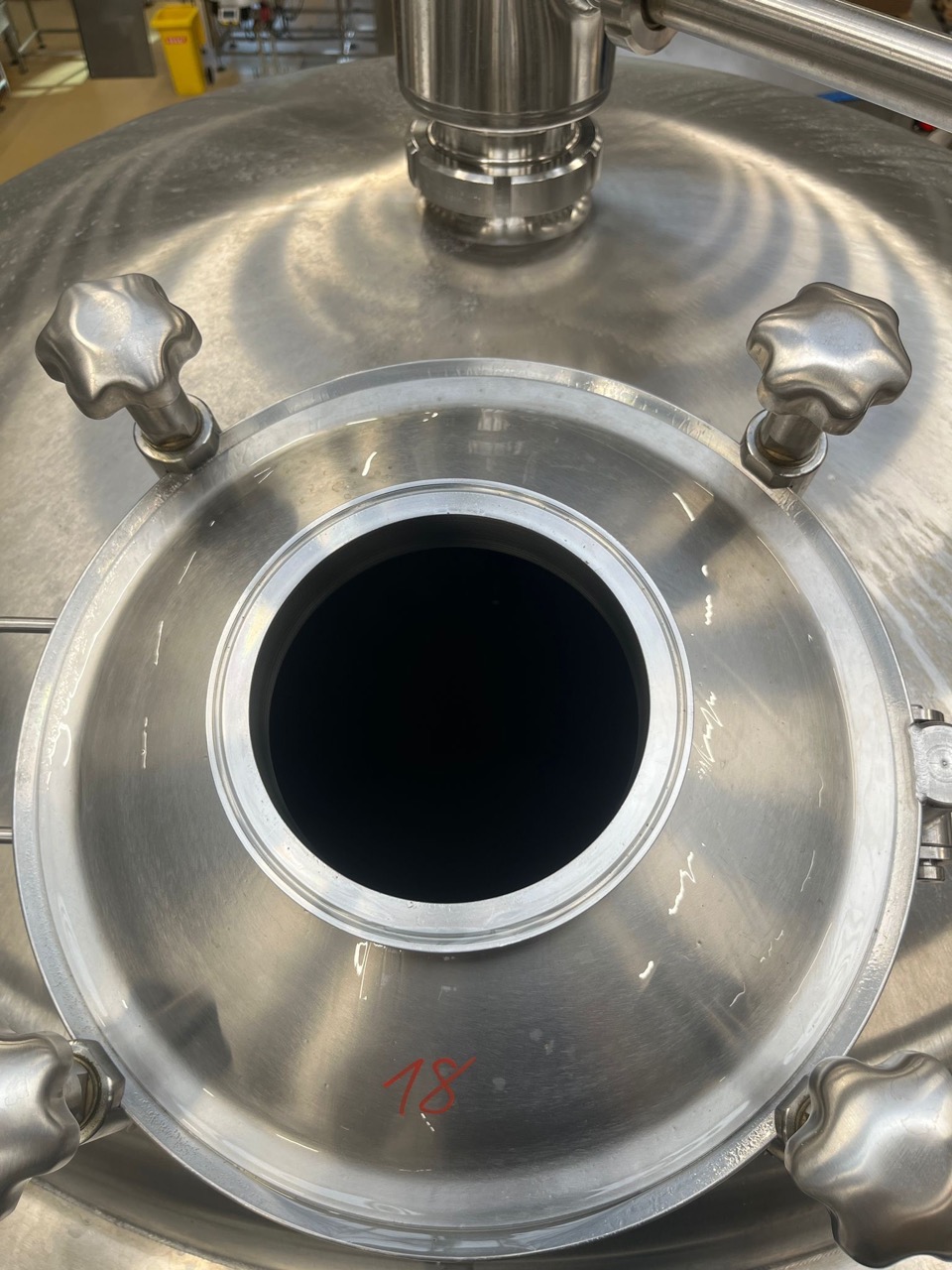
Old tanks (1, 2, 3, 5, 6, 7, 9, 10, 11) and tank 16: 1. Open the manhole.
Spray the open tank interior with alcohol before adding hops.
6. Prep and Add Hops
- Spray hop bags with alcohol before opening.
- Cut bags approximately 50% open.
- HPA hops: these are often compressed into a dense block. If so, place the bag inside a cardboard box and hit it firmly against the floor a few times to break it up. Do not touch the floor directly.
- Add all hops to the tank.
Warning
Before closing the tank, check that no PPE, gaskets, tools, or hop sacks have fallen inside.
7. Close Tank and Continue Bubbling
- Spray the port / manhole and all fittings with alcohol and close.
- Leave the tank bubbling with CO₂ for 20 minutes. Confirm good flow from the CIP arm throughout.
8. Log and Advance Botec Recipe
- Set the Botec fermentation recipe to the Dry Hop step.
- Mark the Dry Hop day in the fermentation spreadsheet.
9. Close CO₂
After 20 minutes, close the tank completely, then close the CO₂.
10. Pressure and Blow-Off — Next Day
Perform this step between 16–24 hours after closing the CO₂.
- Add top pressure via the CIP arm valve to 1 bar.
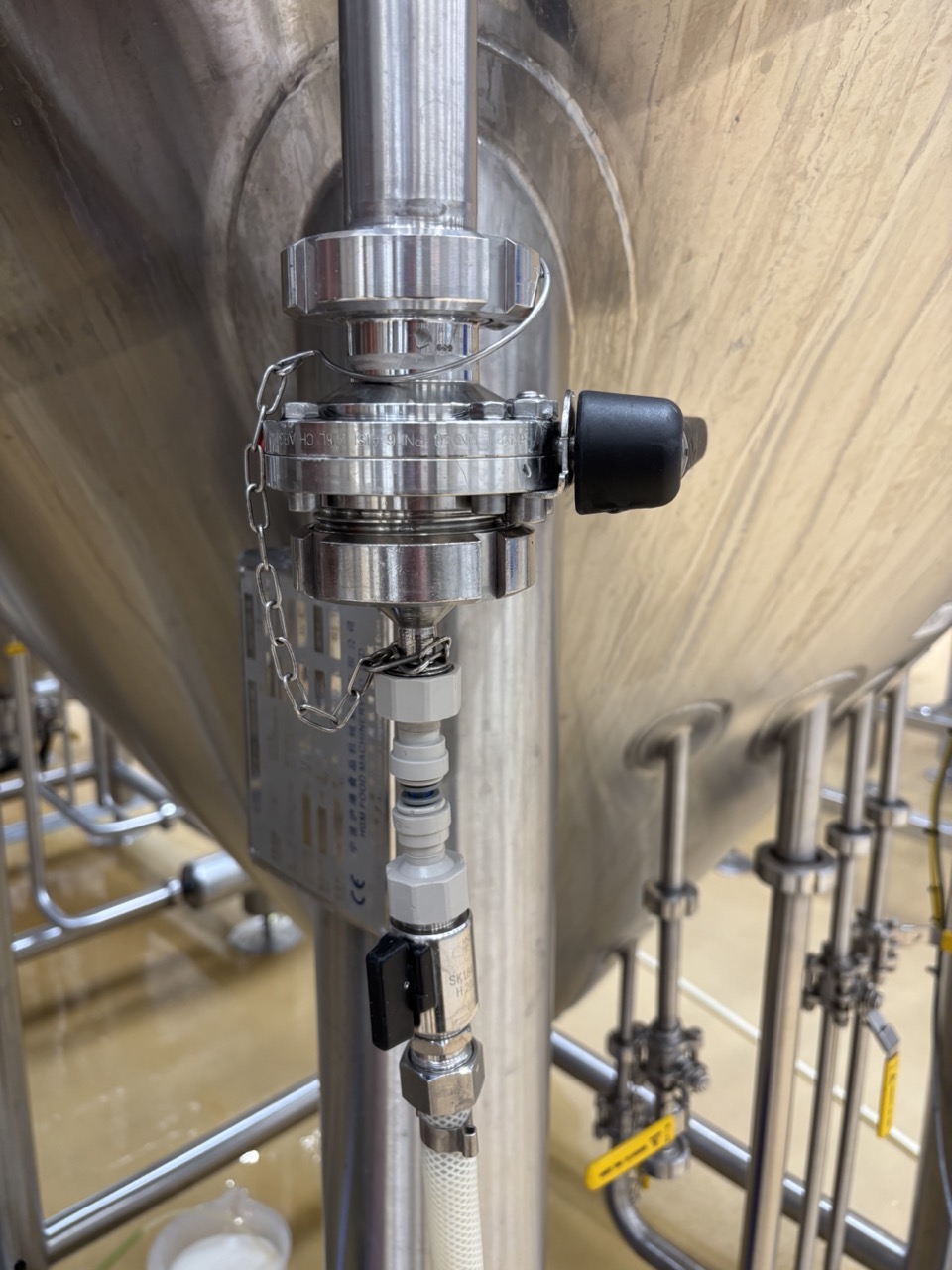
Warning
When disconnecting the CO₂ line, always close the tank/CIP arm valve first, then close the CO₂ line. Closing the CO₂ line first allows beer to run back into the connection under tank pressure.
- Hold for 1 hour.
- Open the CIP arm valve fully to blow off. Close the valve when flow is nearly dead — do not let it empty completely. Leaving a small positive pressure prevents oxygen ingress.
After this step, the Botec recipe advances automatically and begins crashing the beer to spec.
Pre-Run Checklist
- [ ] 2 days at 12°C confirmed (cold DH; warm / West-Coast at 20°C)
- [ ] VLB sample taken (before dry hop)
- [ ] VDK pass confirmed — cold-hopped beers only (warm / West-Coast do VDK after DH)
- [ ] Botec recipe at dry hop step — or discussed with team
- [ ] Yeast dumped (confirm harvest status first)
- [ ] Hops prepped and staged on plastic pallet
- [ ] PAA pitcher and scissors at height
- [ ] CO₂ line attached and purged
- [ ] Head pressure removed via CIP arm
- [ ] Tank open, interior sprayed with alcohol
- [ ] Hop bags sprayed with alcohol before opening
- [ ] HPA hops broken up if required
- [ ] Tank interior checked for foreign objects before closing
- [ ] Tank closed and sprayed with alcohol
- [ ] CO₂ bubbling for 20 minutes confirmed
- [ ] Botec recipe advanced to Dry Hop step
- [ ] Dry hop day marked in fermentation spreadsheet
- [ ] CO₂ closed after 20 minutes
- [ ] Next day: 1 bar top pressure for 1 hour, then blow off to near-empty
Troubleshooting
| Issue | Likely Cause | Action |
|---|---|---|
| Slow foaming during CO₂ bubbling | Normal — CO₂ breaking out of solution | Monitor and continue. Reduce CO₂ flow slightly if concerned. |
| Fast foaming / gushing | CO₂ flow too high or beer highly saturated | Close CO₂ immediately. Open blow-off. Close manhole / port. Wait until blow-off slows and beer settles before continuing. |
| Strong CO₂ flow at start of bubbling | CO₂ breaking out of solution | Normal — will settle after a few minutes. |
| Botec recipe not at dry hop step | Recipe not advanced or incorrect tank selected | Discuss with team before proceeding. Do not dry hop if recipe step is unclear. |