SOP — TPO / CO₂ / O₂ Measurement — Haffmans Handheld
FUERST WIACEK Version 1.4 | Lab — Haffmans handheld meter (used in Cellar & Packaging) | Frequency: per tank reading + per packaging run; deep clean weekly
Purpose
The Haffmans handheld meter measures CO₂, O₂, and TPO in beer. It is used for tank readings during conditioning and for can readings during packaging runs. Results inform whether CO₂ adjustment is needed before packaging and whether the canning line is performing within DO targets.
PPE Required
- Gloves
- Safety goggles when connecting to pressurised tanks
Risks
| Hazard | Risk |
|---|---|
| Pressurised tank connections | Spray of beer or gas if connection not secure |
| Hop particles in meter | Blockage or sensor damage |
Equipment
- Haffmans handheld meter
- DN40 Haffmans line (with DN40 connector — connects to racking arm or standing pipe)
- PAA pitcher
- Alcohol spray
- 5 L pitcher (for tank measurement)
- Mucasol storage solution (1 cap per 1 L water)
Measurement — From Tank
1. Prepare Tank
- Set tank pressure to at least 1 bar via the CIP arm.
- Remove the cap from the racking arm or standing pipe and place it in the PAA bath as usual.
- Dump the racking arm or standing pipe into a large pitcher until the beer runs clean. Use alcohol and a water rinse as per the standard sampling procedure.
- Spray the racking arm or standing pipe down with water, then spray with alcohol.
2. Connect DN40 Line
- Spray down the DN40 Haffmans line with alcohol.
- Connect the line to the tank racking arm or standing pipe. Do not connect to the Haffmans meter yet.
- Open the tank valve and flush the line with beer. Watch the flow — if you see hop particles, keep flushing.
Note
If hop particles keep coming, try closing and opening the tank valve abruptly several times in quick succession. The turbulence this creates often clears the racking arm or standing pipe effectively.
- Once the beer runs clean, connect the line to the Haffmans meter. Before connecting, ensure the Haffmans plunger and screw are open so beer flows through the meter immediately on connection.
3. Set Measurement Mode
Set the Haffmans to CO₂ / O₂ measurement mode.
4. Set Flow and Stabilise
- Adjust the flow rate using the side screw so the beer does not foam. Aim to maintain the same pressure reading as the tank — e.g. 1 bar.
- Let beer flow through the meter into the drain. The outlet should fill a 5 L pitcher before you take any readings.
Warning
Do not take readings before the 5 L pitcher is full. The meter needs time to equilibrate to the temperature of the beer. Readings taken before this point are unreliable.
- Check the drain line — beer should exit in a smooth, short flow with no foaming.
5. O₂ Reading
After the 5 L pitcher is full, check the O₂ reading. Expected range is 50–60 ppb. If higher, discuss with the team — something is off.
Note
50–60 ppb is on the higher side but is our normal baseline for tank readings.
6. CO₂ Readings
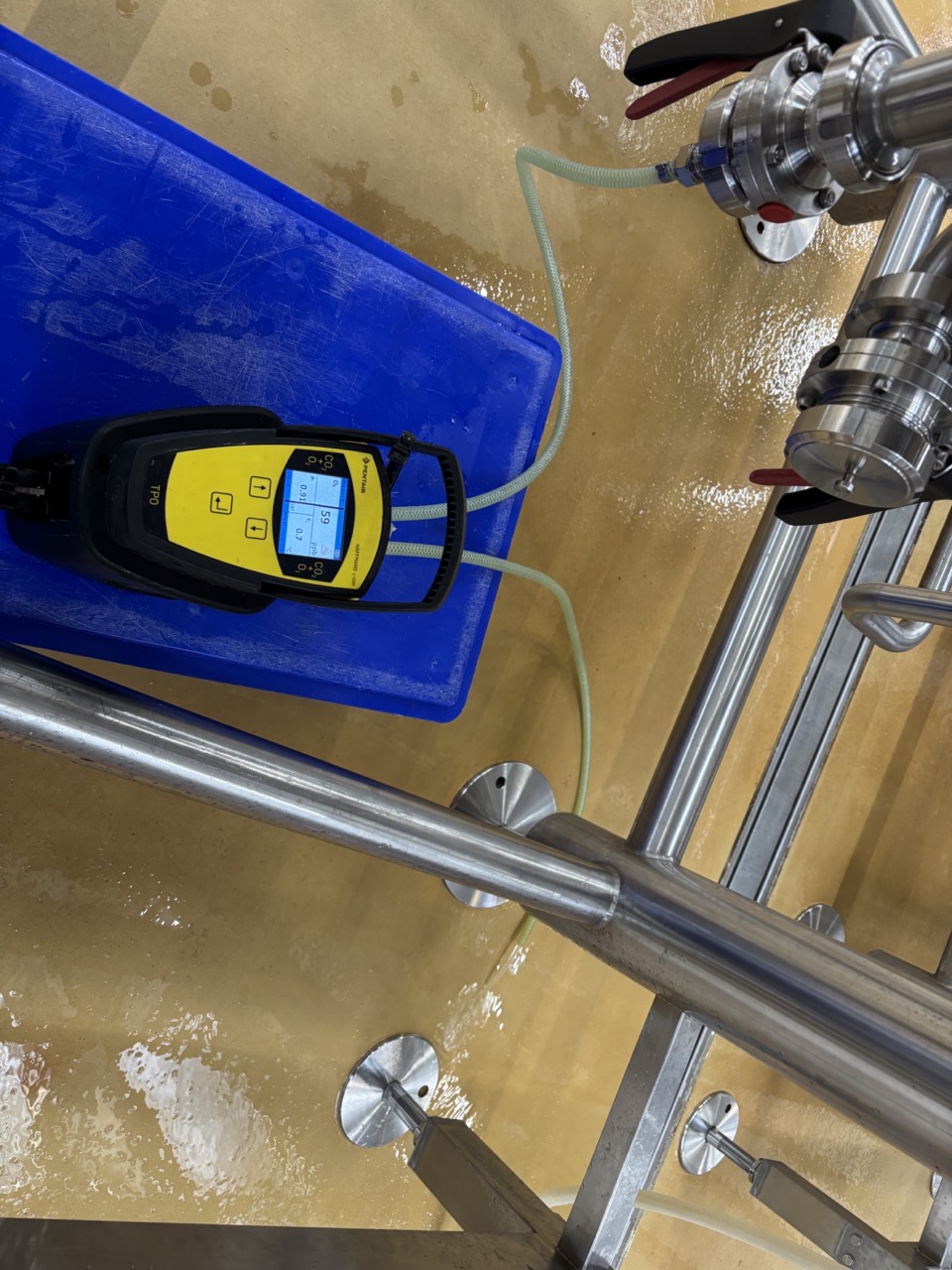
- Close the plunger. Wait for a CO₂ reading to appear and note it.
- Open the plunger and let beer flow for approximately 1 minute.
- Close the plunger again and take the next reading.
- Repeat until you have 3 consecutive readings that are consistent and make sense. Call that as your result.
7. Disconnect and Clean
- Open the plunger and disconnect the Haffmans from the line.
- Connect the Haffmans to the water supply at the panel and rinse through.
- If hop particles have entered the meter: close and open the plunger several times while rinsing. Backflushing can also help clear particles.
- When finished with all readings for the day, fill the meter with Mucasol solution at the canning line.
8. Log Results
Record CO₂ and O₂ in the fermentation spreadsheet. If this is a pre-packaging reading, also log in the packaging sheet.
9. CO₂ Adjustment
Once you have a confirmed CO₂ reading, compare it against the target for the beer. For the full guide on what action to take — bubble, rouse, or vent — refer to the Carbonation SOP.
Measurement — From Can
This measurement is taken during packaging runs to monitor TPO and O₂ in filled cans.
Setup
- Set the Haffmans to TPO / O₂ measurement mode.
- Check the can piercer height — cans are placed upside down and there should be 3–4 mm clearance between the rubber seal and the can surface. Adjust if needed.
- Confirm CO₂ is open in the line.
- Set flow to a slow rate — unlike tank measurement, liquid volume from a can is limited.
Procedure
- Rinse with first can. The first reading after any break of 15+ minutes is typically elevated and not usable. Always discard the first can as a rinse.
- Take the next can. Shake it vigorously up and down for a few minutes — not side to side. Up-and-down motion produces more realistic (higher) readings.
- Place the can upside down in the piercer.
- Pierce the can, push down the spear, and open CO₂. Let beer flow through the Haffmans.
- Watch for the first bubble at the piercer outlet — this signals the can is nearly empty. Close the plunger immediately and initiate the measurement.
- Once reading is complete: close CO₂, open the plunger, open the piercer, pull up the spear, and discard the can.
Targets and Action
| Result | Action |
|---|---|
| 50–70 ppb | Acceptable — monitor and continue |
| Creeping upward | Adjust canning line — e.g. reduce bowl pressure |
| Consistently above target | Escalate to team. Consider removing cans from collection table. Refer to Canning Line Operation SOP. |
Note
Can readings are not logged here. They are read digitally and entered into the packaging sheet later.
Storage and Care
- After use: rinse with water, then fill with Mucasol solution (1 cap per 1 L water) at the canning line.
- If hop particles are present: flush with water, close and open plunger several times, backflush if needed.
Maintenance
| Task | Frequency | Notes |
|---|---|---|
| Rinse and fill with Mucasol | After every use | 1 cap per 1 L water |
| Deep clean | Monthly | Disassemble, replace and lubricate seals. Refer to Haffmans manual. |
Note
No routine calibration is required.
Spare Seals — Landefeld Part Numbers
Seals are available from Landefeld as a cheaper alternative to ordering direct from Haffmans. Match by Haffmans part number to find the correct Landefeld equivalent.
| O-ring size | Haffmans part no. | Location | Landefeld part no. |
|---|---|---|---|
| 5 × 2 mm | 100.048 | Kalibrierschraube | OR 5X2 N |
| 7.5 × 2 mm | 100.082 | Flowschraube | OR 7.5X2 N |
| 7.65 × 1.78 mm | 101.040 | Schlauchanschlüsse | OR 7.66X1.78 N |
| 9.26 × 1.78 mm | 101.042 | Schlauchanschlüsse | — |
| 9.25 × 1.78 mm | 000.745 | O-Ring um den Kolben | OR 9.25X1.78 N |
Troubleshooting
| Issue | Likely Cause | Action |
|---|---|---|
| Reading won't stabilise | Foaming in meter or insufficient flow time | Adjust flow rate with side screw. Ensure 5 L pitcher is full before reading. |
| Hop particles in meter | Insufficient flushing before connecting | Flush DN40 line until clear before connecting to meter. If already in: rinse, close/open plunger repeatedly, backflush. |
| O₂ reading above 60 ppb | Possible leak or contamination | Check all connections. Discuss with team. |
| First can reading elevated | Air in line / line not primed | Always rinse with first can after any break of 15+ minutes. |
| CO₂ readings inconsistent | Beer not yet temperature-equilibrated, or flow too fast | Wait for 5 L to pass. Slow the flow. Repeat until 3 consistent readings. |