SOP — Chemical Management
FUERST WIACEK Version 1.2 | Utilities — chemical handling, storage, and dosing | Frequency: as needed (barrel swaps, stock checks)
Purpose
This SOP covers safe handling and storage of all chemicals used in the brewery, monitoring stock levels, swapping barrels and containers when getting low, transferring residual chemical, disposing of empties, and ordering new stock. It also covers the caustic dosing unit blockage procedure.
PPE Required
Warning
Always wear full PPE when handling chemicals. Acid in particular is highly aggressive — even a small drip can damage the floor or cause burns.
- Safety goggles
- Chemical-resistant gloves
- Closed-toe footwear
Chemical Overview
| Chemical | Product Code | Container | Used by |
|---|---|---|---|
| Caustic | IC 1002 | Large barrel | CIP Tank 1 (brewhouse/wortway), CIP Tank 2 (canning) |
| Acid | IC 3002 | Large barrel | CIP Tank 1 (brewhouse/wortway), canning line inline dosing |
| PAA | DI 1011 | ~20 L container | Manual dosing — tanks, brink, kegs |
| Alcohol | — | Small container | Sanitation, lab |
| Foam gun chemical | — | Small container | Canning line foam-down |
Chemical Safety Rules
These rules apply at all times, regardless of which chemical you are handling.
Acid (IC 3002)
Warning
Acid is highly corrosive. If acid drips onto the floor, immediately spray the area thoroughly with the water spray gun. Do not leave acid on the floor even briefly — it will damage the surface.
Always keep the acid hose under control when removing or inserting lances or connections. Never allow drips.
Chlorine-Based Chemicals
Warning
Chlorine-based chemicals corrode stainless steel. If you use any chlorine-based product near stainless steel, rinse all contact surfaces immediately and thoroughly with a large amount of water. Do not allow chlorine residue to remain in contact with stainless steel.
General Chemical Handling
- Never mix chemicals.
- Always label containers clearly if decanting.
- Store chemicals in their designated areas only.
- If unsure about a chemical or a spill situation, ask Lukasz.
Barrel Management (Caustic and Acid)
Caustic (IC 1002) and acid (IC 3002) are supplied in large barrels. Each chemical has a designated storage area with two types of lance:
- Automatic dosing lance — connects to the CIP dosing unit. This must always be in a barrel with sufficient volume.
- Manual pump lance — used for manual dosing tasks. Can remain in the old barrel when the automatic lance is moved.
Monitor Barrel Levels
Check barrel levels as part of regular CIP preparation. Botec will alarm when the volume drops below a threshold — do not wait for this alarm. Swap the automatic dosing lance before the barrel runs that low. Running a CIP with insufficient chemical wastes the cycle and can run the dosing pump dry, which may cause a blockage.
Order new stock when down to 1 full unopened barrel remaining. That is the latest point to place an order. Inform Lukasz and the team.
Swap the Automatic Dosing Lance
When the current barrel is getting low:
- Open the new barrel. Set the white caps aside — you will need them to close the empty barrel later.
- Remove the automatic dosing lance from the old barrel.
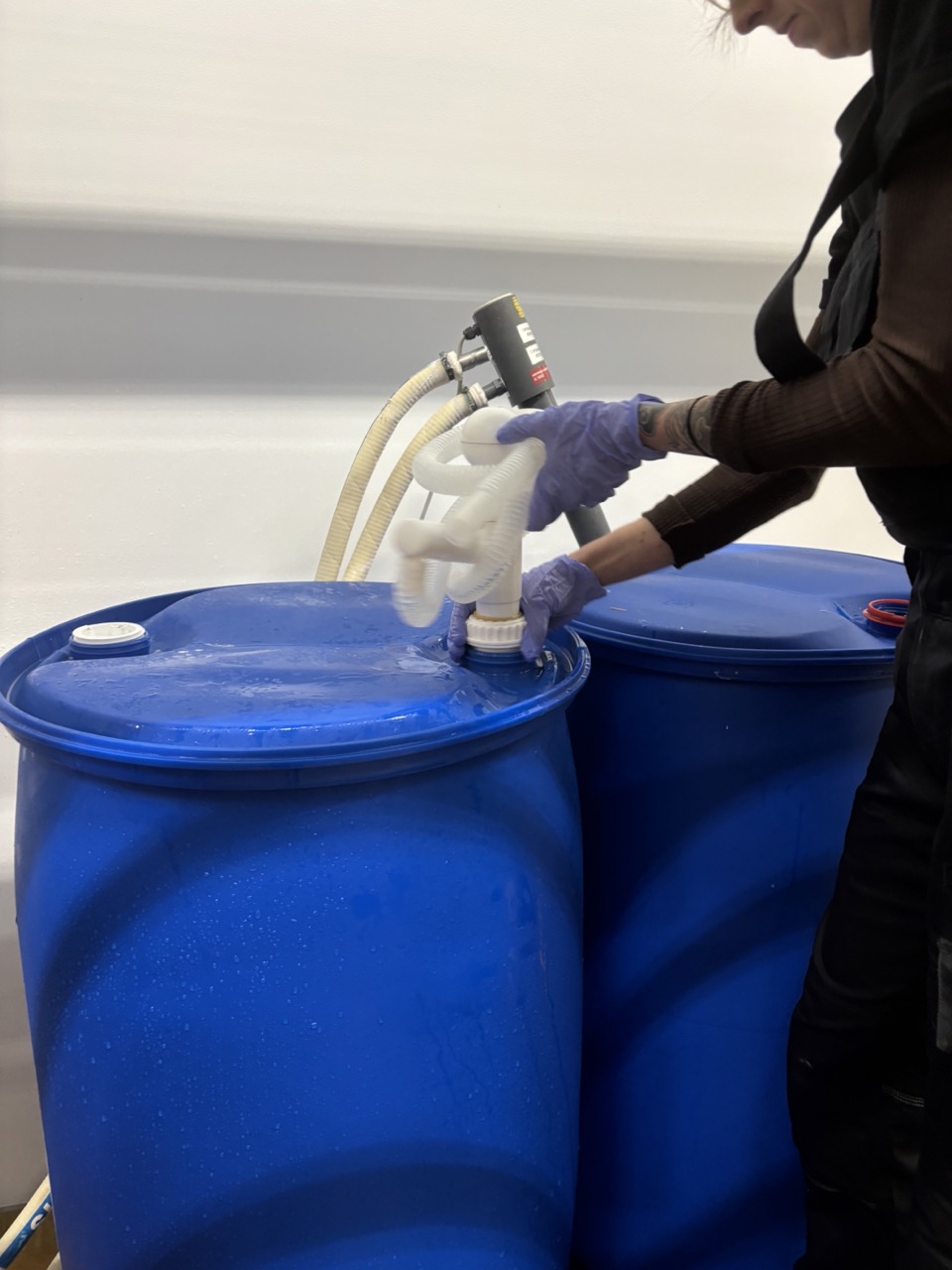
Warning
When removing or installing the lance, keep the hose under control at all times. Do not let it drip freely — especially acid, which damages the floor on contact.
- Insert the automatic dosing lance into the new barrel. Ensure it is seated fully.
- The manual pump lance can stay in the old barrel for now — use it to transfer the residual.
Transfer Residual Chemical
When the old barrel is nearly empty, use the manual pump to transfer the remaining chemical into the new barrel rather than wasting it.
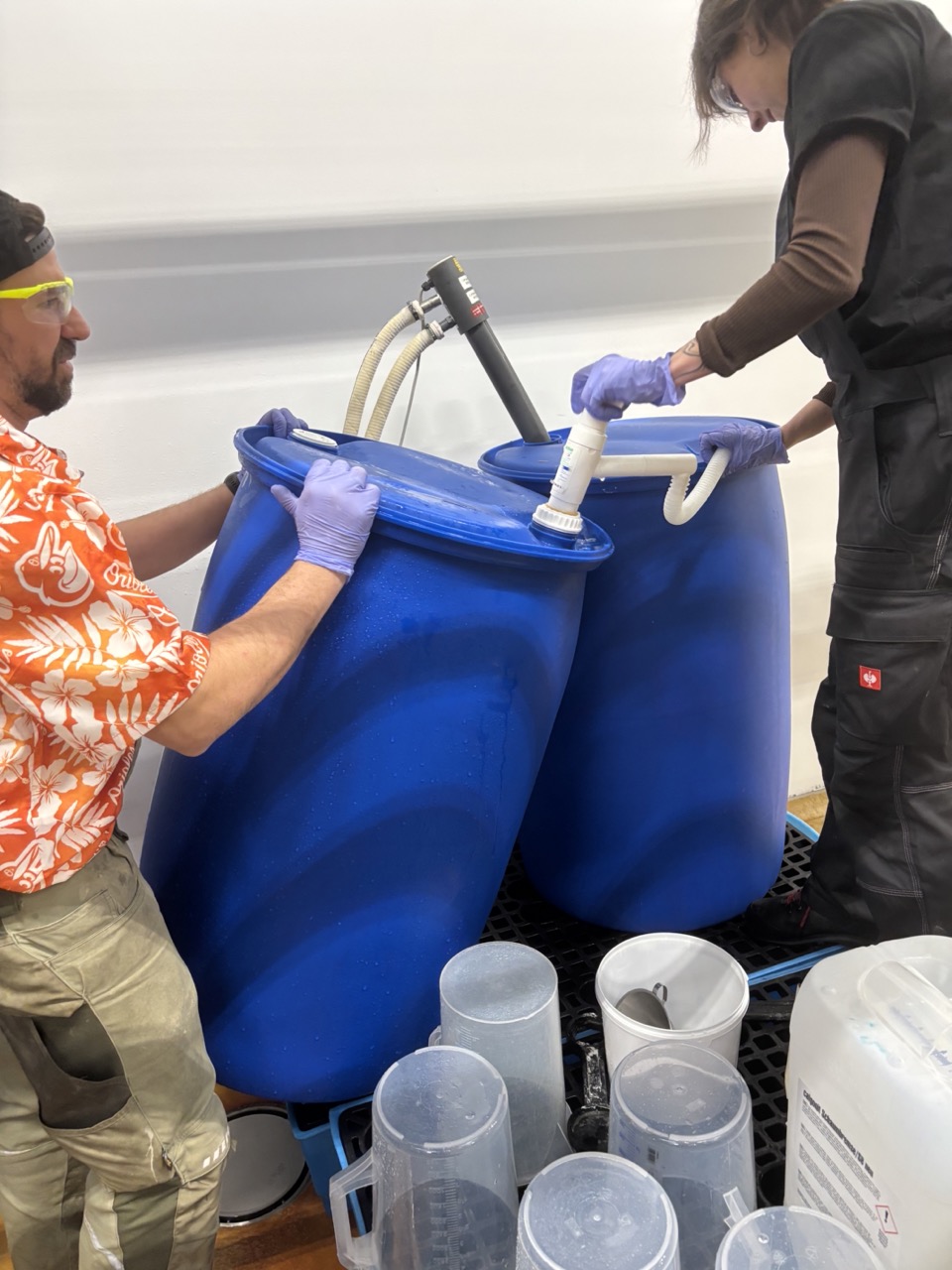
This is a two-person job:
- One person tilts the old barrel slightly — the manual pump can empty it completely when tilted.
- The second person operates the manual pump, pumping the residual chemical into the new barrel.
- Continue until the old barrel is empty.
Rinse and Dispose of the Empty Barrel
- Using a water spray gun, rinse the outside of the barrel thoroughly.
- Rinse the inside briefly and drain completely.
- Fit the white caps back onto the barrel openings to seal it.
- Move the sealed barrel outside to the pallet area with the other empties.
Container Management (PAA and Small Containers)
PAA (DI 1011)
PAA is supplied in ~20 L containers. There is no automatic dosing lance — PAA is always dosed manually.
Monitor the container level as part of regular cellar work. Order new stock when down to 1 full unopened container remaining. Inform Lukasz and the team.
When a container is empty: throw it in the bin. Do not rinse PAA containers.
Small Containers (Alcohol, Foam Gun Chemical, etc.)
Small containers — alcohol, foam gun chemicals, and similar — go in the bin when empty. Do not rinse.
Communicate to the team and Lukasz when down to 1 unit remaining of any small container product. That is the latest point to reorder.
Brush Colour Code
Brushes are colour-coded to prevent cross-contamination between areas. Never use a brush outside its designated zone.
| Colour | Zone | Examples |
|---|---|---|
| Yellow | Malt room only | Grist case top, malt dust areas |
| Red | Product-contact surfaces | Tank interior, manway, Zwickel, racking arm, seamer wheel, CO₂ channels |
| Blue | External surfaces — fermentors, brewhouse, floor | Outside of tanks, brewhouse floors, general brewery surfaces |
| Orange | Greasy / heavy-biofilm areas — canning line | Line conveyers, lubricant points, areas with grease or heavy organic buildup |
| Green | Glycol room | All surfaces in the glycol room (highest biofilm risk) |
| Black | Warehouse | Warehouse floors and surfaces |
Warning
Do not bring a red brush out of the cellar/brewhouse into the canning line, malt room, or warehouse. Do not bring any non-red brush into contact with product surfaces. If in doubt, ask.
Caustic Dosing Unit Blockage
Warning
If the caustic dosing unit becomes blocked, contact Lukasz before attempting to fix it yourself.
The caustic dosing unit can block 1–2 times per year. Caustic crystallises into a crust inside the lance and pump when the barrel is allowed to run completely dry. The fix:
- Detach the lance from the dosing pump.
- Rinse the lance and pump system through with hot water from the panel until the blockage clears.
This procedure is not fully documented — ask Lukasz for help when it occurs.
Checklist
Barrel swap (caustic or acid)
- [ ] New barrel opened — white caps set aside for later
- [ ] Automatic dosing lance removed — hose kept under control, no drips
- [ ] Automatic dosing lance fully seated in new barrel
- [ ] Manual pump lance remains in old barrel for residual transfer
Residual transfer
- [ ] Two-person job confirmed
- [ ] Barrel tilted — residual pumped into new barrel
- [ ] Old barrel confirmed empty
Empty barrel disposal
- [ ] Outside rinsed with spray gun
- [ ] Inside briefly rinsed and drained
- [ ] White caps fitted to seal the barrel
- [ ] Barrel moved to outside pallet area
Stock monitoring
- [ ] Team and Lukasz informed when down to 1 full barrel of caustic or acid
- [ ] Team and Lukasz informed when down to 1 container of PAA
- [ ] Team and Lukasz informed when down to 1 unit of any small container product
Troubleshooting
| Issue | Likely Cause | Action |
|---|---|---|
| Botec low-chemical alarm during CIP | Barrel ran too low before swap | Complete CIP if possible. Swap to new barrel immediately. Swap earlier next time. |
| Caustic dosing pump blocked | Barrel ran dry, caustic crystallised | Do not run CIP. Contact Lukasz. Flush system with hot water from panel. |
| Acid on floor | Drip or spill during lance handling | Spray area with large amount of water immediately. |
| CIP running with wrong chemical concentration | Lance not fully inserted in new barrel | Stop CIP. Ensure lance is fully seated. Restart CIP. |