SOP — Yeast Brink CIP
FUERST WIACEK Version 1.3 | Cellar — yeast brink | Frequency: before every yeast harvest
Purpose
This SOP covers the CIP of the yeast brink before harvesting. The sequence is caustic → water rinse → acid → water rinse → PAA → empty PAA. The process uses the mobile pump and mobile dosing tank — the same method as the tank CIP and kegger CIP.
Yeast harvest is covered in the Yeast Harvest SOP.
Chemical Dosing Reference
| Step | Chemical | Amount | Water | Temp | Time |
|---|---|---|---|---|---|
| Caustic | IC 1002 | TBD | 80 L | Cold | 20 min |
| Acid | IC 3002 | TBD | 80 L | Cold | 20 min |
| PAA | DI 1011 | TBD | 80 L | Cold | 20 min |
PPE Required
Warning
Do not handle chemicals without full PPE.
- Safety goggles
- Chemical-resistant gloves
- Ear protection
Risks
| Hazard | Risk |
|---|---|
| Chemical exposure | Burns, eye damage / blinding |
| Running pump dry | Pump damage — never run without liquid in the inlet |
| Compressed air | Can expel liquid at force — control flow carefully |
| Noise | Wear ear protection throughout |
Equipment
- Yeast brink (clean and free from heavy soilage before starting)
- Mobile pump (cellar pump) with T-piece on inlet
- Mobile dosing tank
- DN40 and DN25 hoses
- Caustic (IC 1002)
- Acid (IC 3002)
- PAA (DI 1011)
- Compressed air line
- PAA bath (for sanitising harvest connection after CIP)
- Water hose
Process
1. Assemble CIP Circuit
The circuit runs: chemical dosing tank → pump → T-piece at harvest tank → bottom of brink → top of brink → chemical dosing tank (return).
Pump connections:
The pump inlet is fed from the chemical dosing tank. The pump outlet connects to the side of the T-piece at the harvest tank.
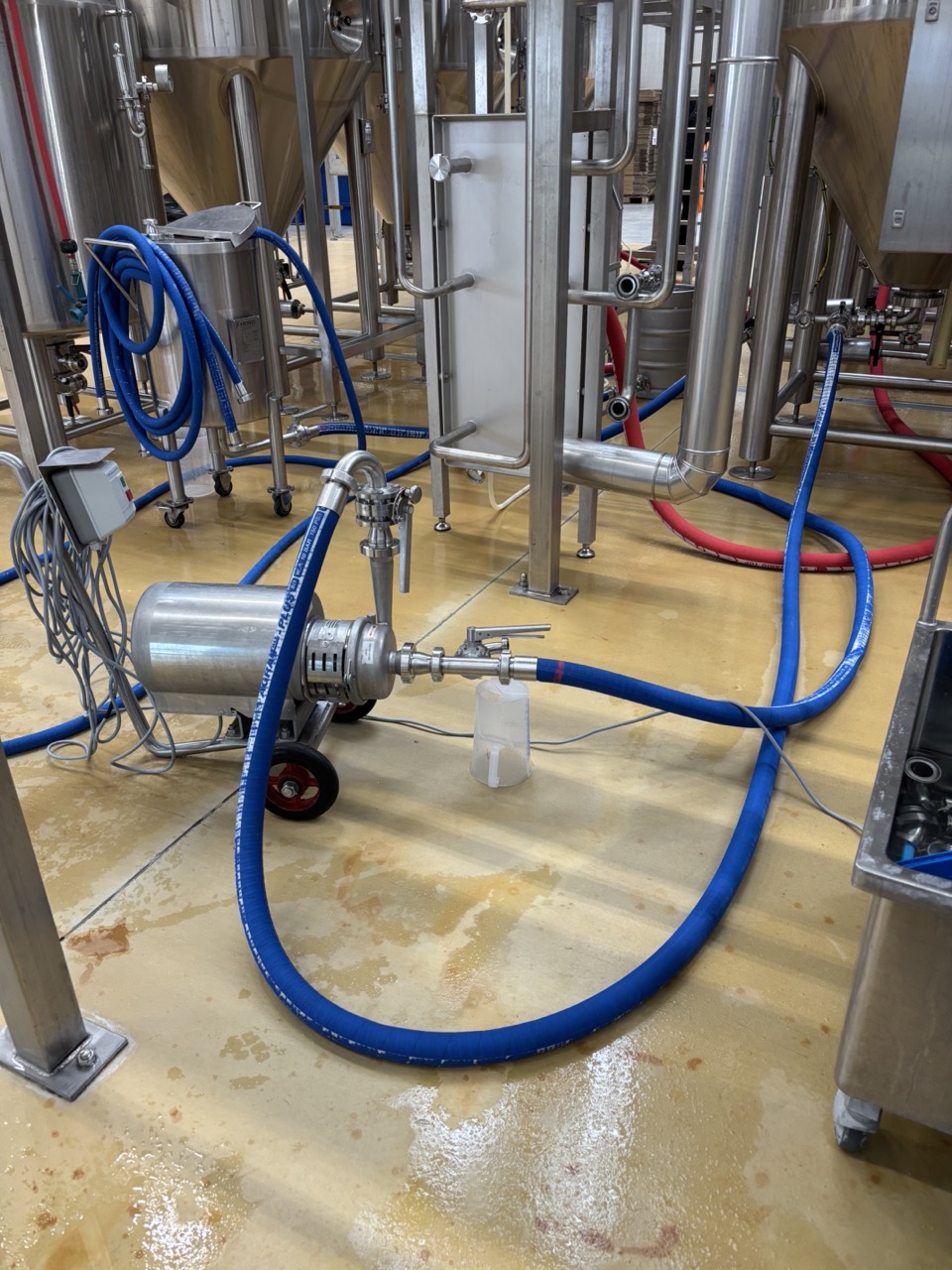
Bottom of brink (inlet):
A short DN40 hose with a hand valve connects the front of the T-piece at the harvest tank to the bottom connection of the brink.
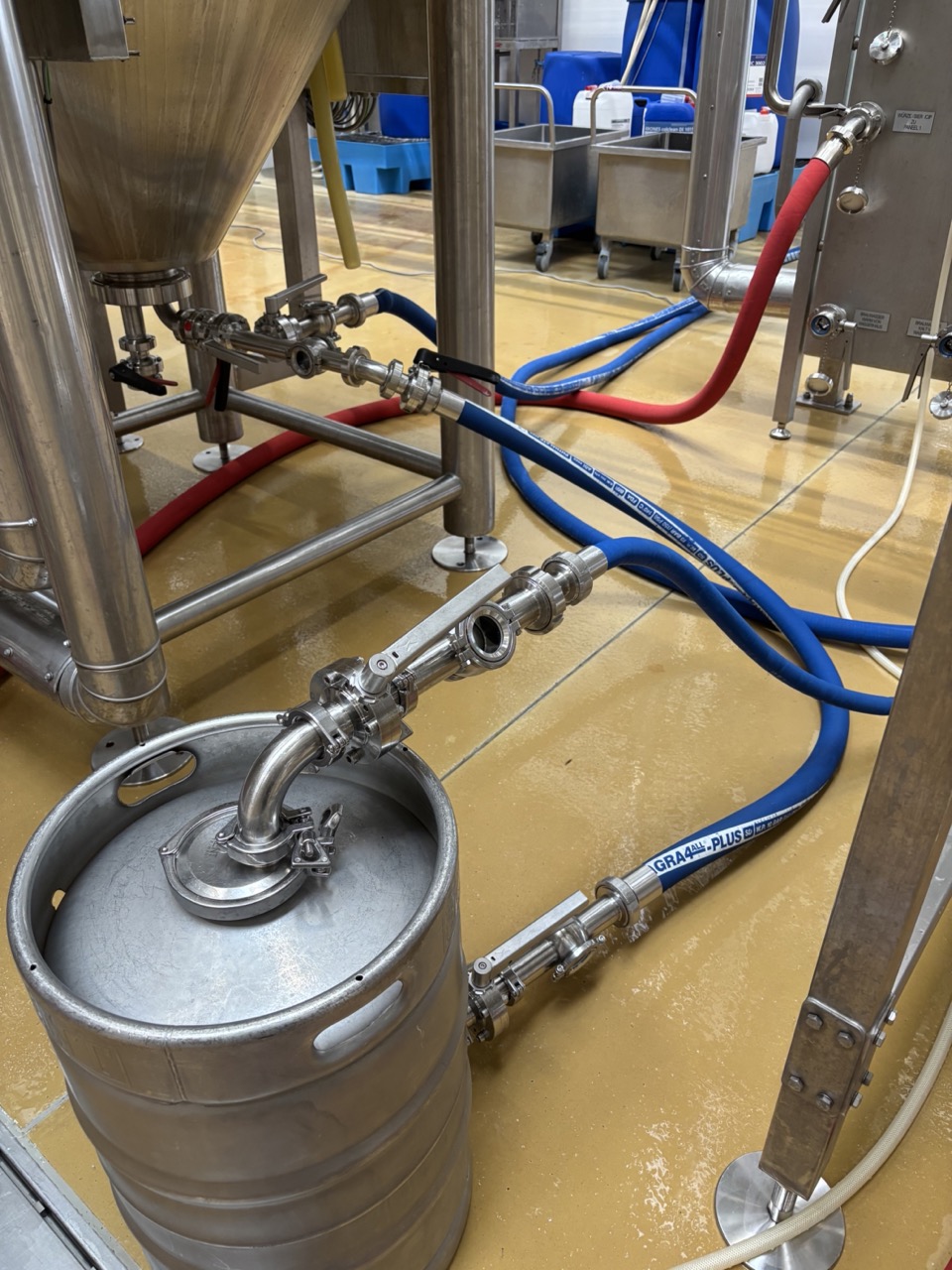
Top of brink (return):
A DN25 line from the top of the brink returns to the chemical dosing tank to complete the recirculation loop.
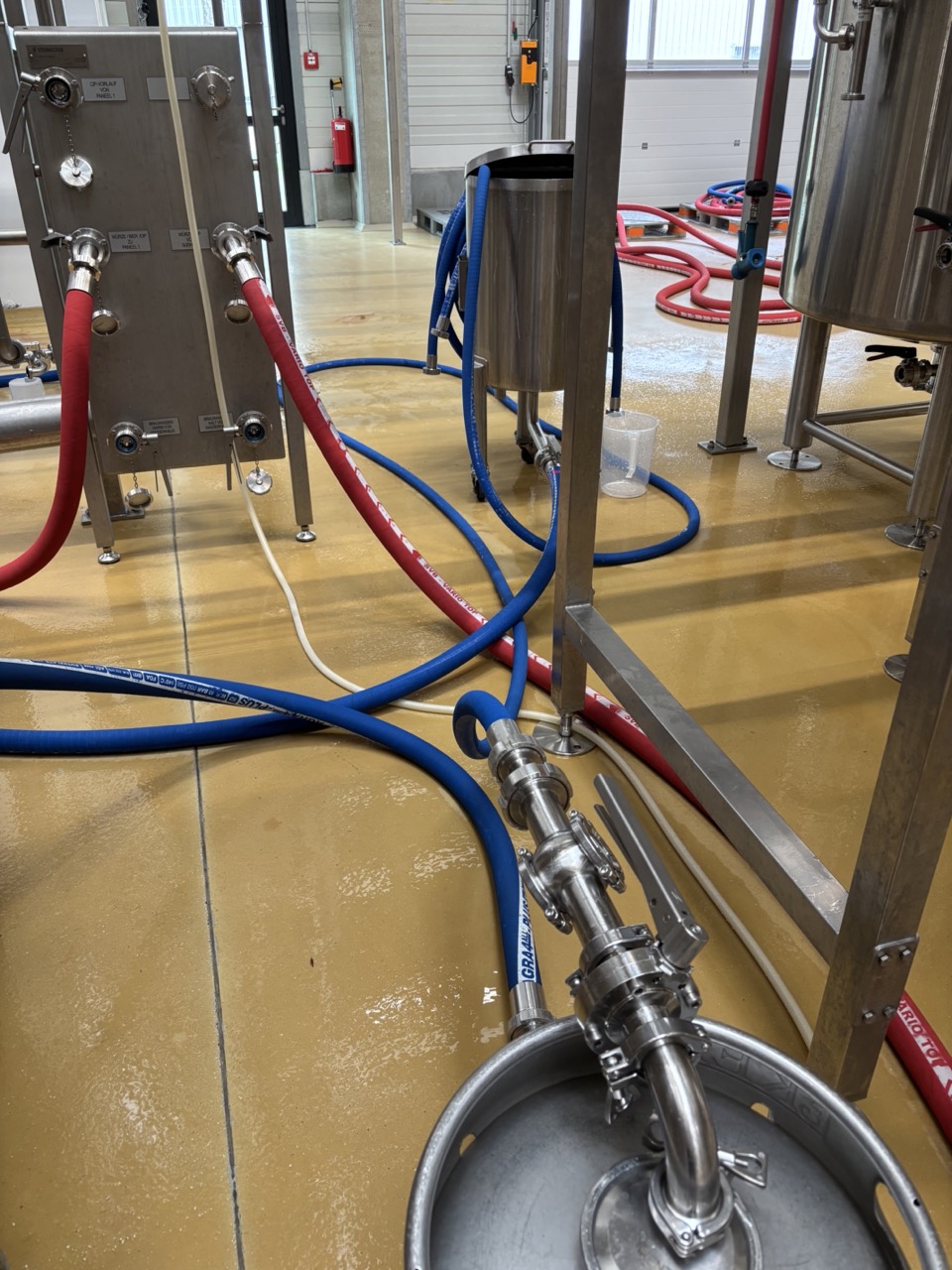
Rinse the line with water to fill the brink and prime the circuit before starting CIP chemicals.
2. Caustic — 20 Minutes
- Fill the dosing tank with water. Add caustic (IC 1002) to concentration for the brink volume.
- Close the water source once the brink is primed. Close the pump delivery flow control.
- Place the CIP return hoses into the dosing tank — use extra fittings to keep the return end submerged during recirculation.
- Turn on the pump, open the delivery flow control slowly. Confirm flow is circulating.
- Recirculate for 20 minutes. Turn off the pump.
3. Remove Caustic
- Connect the CIP return hose to compressed air. Set to the lowest possible pressure.
Warning
Caustic will exit at force under compressed air. Keep PPE on and stand clear of the outlet.
- Open the valves and push caustic back to the dosing tank or to drain.
- Once the line is empty, tilt the brink sideways to drain the last volume from the bottom.
- Close the compressed air and disconnect.
4. Water Rinse
- Connect CIP delivery to the water source. Open at a controlled flow rate.
- When water appears at the return outlet, close the water source and disconnect.
- Connect CIP return to compressed air and push the water out until air comes through. Close and disconnect.
- Reconnect delivery to water source and rinse again until water appears at the return.
- Check conductivity at the return outlet — target < 0.15 mS. Repeat if still present.
5. Acid — 20 Minutes
- Fill the dosing tank with water. Add acid (IC 3002) to concentration.
Note
Ensure the dosing tank is neutral before adding acid — rinse the tank if caustic residue remains.
- Place CIP return hoses into the dosing tank. Turn on the pump, open flow control, confirm recirculation.
- Recirculate for 20 minutes. Turn off the pump.
6. Remove Acid
Repeat the compressed air push as in step 3. Tilt the brink to drain fully.
7. Water Rinse — Post Acid
Repeat the water rinse as in step 4. Check conductivity — target < 0.15 mS before proceeding to PAA.
8. PAA — 20 Minutes
- Fill the dosing tank with water. Add PAA (DI 1011) to concentration.
- Place CIP delivery and return hoses into the dosing tank. Turn on the pump, open flow control, confirm recirculation.
- Recirculate for 20 minutes. Turn off the pump.
9. Empty PAA and Prepare for Harvest
- Connect the CIP return to compressed air.
- Close the valves on the brink and the T-piece side connection.
- Disconnect the hose from pump delivery to T-piece and place the open end at the drain.
- Open the T-piece side valve. Purge a small amount of yeast or trub from the tank full drain to the drain. Close the full drain.
- Open the valves on the brink. Open the compressed air and push the residual PAA to drain. Tilt the brink on its side to remove the last volume.
- Close the compressed air.
- Close the T-piece side connection and the butterfly valve on top of the brink.
- Disconnect the CIP return line from the brink. Submerge the open connection end in the PAA bath — keep it sanitised for the harvest connection.
The brink is now ready for harvest — refer to the Yeast Harvest SOP.
Checklist
- [ ] Brink free of heavy soilage before starting
- [ ] CIP circuit assembled, water source primed
- [ ] Caustic circulated 20 min — pushed out with compressed air, brink tilted to drain fully
- [ ] Water rinse — conductivity < 0.15 mS
- [ ] Acid circulated 20 min — pushed out with compressed air, brink tilted to drain fully
- [ ] Water rinse — conductivity < 0.15 mS
- [ ] PAA circulated 20 min — pushed to drain with compressed air, brink tilted to drain fully
- [ ] CIP return connection submerged in PAA bath
Troubleshooting
| Issue | Likely Cause | Action |
|---|---|---|
| Pump cavitating / low flow | Air in pump or inlet not flooded | Turn off. Bleed air from delivery side, retighten, restart. |
| Chemical not fully drained after air push | Brink not tilted | Tilt brink on its side to drain the remaining volume. |
| Conductivity not reaching target | Insufficient rinse volume | Continue rinsing. Recheck conductivity. |