SOP — Pump Motor Electrical Diagnostics
FUERST WIACEK Version 1.0 | Utilities — all pump motors | Frequency: when a pump fails to start or runs abnormally
Purpose
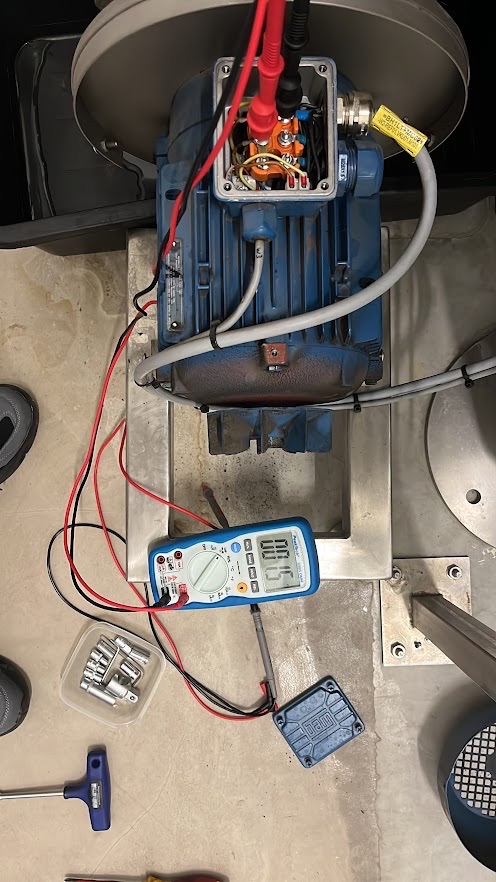
This SOP covers basic electrical diagnostics on three-phase pump motors using a multimeter. The test determines whether a motor winding has an open circuit (break), a short circuit, or a ground fault — helping isolate whether the fault is electrical (motor or wiring) or mechanical (pump head, shaft, impeller).
⚠️ Safety — Read Before Starting
Risk of death — do not work alone
Always call Lukasz before opening any electrical box or performing this test. Three-phase power is lethal. Power must be isolated, locked out, and verified dead before any electrical box is opened or any measurement is taken.
- Power off at the motor control panel or distribution board
- Lock out / tag out — physically prevent the breaker from being switched back on while you are working
- Verify with a multimeter that no voltage is present at the motor terminals before touching anything
- Do not work alone — a second person must be present
Equipment
- Multimeter (resistance / Ω mode)
- Insulated gloves
- Lockout/tagout device
- Screwdriver / hex key for terminal box cover
Background — Star vs. Delta Wiring
Three-phase motors are wired in one of two configurations. The configuration affects the resistance values you expect when measuring — check the motor nameplate before measuring.
| Configuration | German | Symbol | Wiring |
|---|---|---|---|
| Star | Stern | Y | Three windings meet at a central neutral point |
| Delta | Dreieck | Δ | Three windings connected end-to-end in a triangle |
Star (Y): Measuring between any two terminals gives you two windings in series. All three phase-to-phase readings should be equal. Values are typically a few ohms to tens of ohms depending on motor size.
Delta (Δ): Measuring between two terminals gives one winding in parallel with two in series. All three phase-to-phase readings should still be equal to each other, but the absolute values will be lower than in a star-wired motor of the same power rating.
The key point in both cases: the three phase-to-phase readings must be equal to each other. Asymmetry means a fault.
Process
1. Isolate and Verify
- Switch off the motor at the control panel or breaker.
- Lock out the breaker — physically prevent it from being switched back on.
- Open the motor terminal box cover.
-
Using the multimeter in voltage mode, verify that no voltage is present between any two terminals, and between each terminal and ground.
Danger
Do not proceed until voltage reads 0 V on all combinations.
2. Identify Configuration
Read the motor nameplate. Confirm whether the motor is wired Star (Stern / Y) or Delta (Dreieck / Δ).
3. Measure Phase-to-Phase Resistance
Switch the multimeter to resistance (Ω) mode.
Measure resistance between each pair of terminals (L1–L2, L2–L3, L1–L3):
| Measurement | Expected result |
|---|---|
| L1 – L2 | Low, consistent value (few Ω) |
| L2 – L3 | Same as above |
| L1 – L3 | Same as above |
All three readings must be equal. Note the values.
| Reading | Interpretation |
|---|---|
| All three equal, low resistance | Windings intact — motor likely not the fault |
| One or more readings are OL / infinite | Open circuit — broken winding — motor needs rewinding or replacement |
| One or more readings are near 0 Ω | Short circuit between windings — motor needs rewinding or replacement |
| Readings differ significantly between phases | Partial fault — investigate further or replace motor |
4. Measure Phase-to-Ground (Insulation Check)
Measure resistance between each terminal (L1, L2, L3) and the motor casing / ground terminal (PE):
| Reading | Interpretation |
|---|---|
| Very high (megaohms, or OL) | Good insulation — no ground fault |
| Low resistance (< 1 MΩ) | Insulation breakdown — ground fault — motor is unsafe, do not run |
| Near 0 Ω | Direct short to ground — motor must not be used |
Note
A standard multimeter may read OL on all ground measurements — this is normal and means the insulation resistance is beyond its range. A proper insulation resistance tester (megohmmeter / Megger) gives a precise value. For brewery purposes, OL on a standard multimeter is a passing result.
5. Record and Report
Record all six readings (3 phase-to-phase + 3 phase-to-ground) along with the motor name, location, and date. Report findings to Lukasz before any decision is made about repair or replacement.
Checklist
- [ ] Lukasz notified and present or approved work
- [ ] Power switched off at control panel / breaker
- [ ] Lockout/tagout applied
- [ ] Voltage verified at 0 V on all terminal combinations before touching
- [ ] Motor configuration (Star/Delta) confirmed from nameplate
- [ ] L1–L2, L2–L3, L1–L3 resistance measured and recorded
- [ ] L1–PE, L2–PE, L3–PE resistance measured and recorded
- [ ] Results reported to Lukasz
Troubleshooting / Interpretation Guide
| Symptom | Likely cause | Next step |
|---|---|---|
| All phase readings equal, no ground fault, but motor still won't run | Fault is not in the motor windings — check contactor, fuses, control circuit | Call Lukasz |
| One phase reading OL (infinite) | Open winding — motor faulty | Replace or rewind motor |
| One phase reading near 0 | Short circuit in winding | Replace or rewind motor |
| Phase readings unequal | Partial winding damage | Replace or rewind motor |
| Any phase-to-ground reading low | Insulation failure | Do not run motor — replace |